

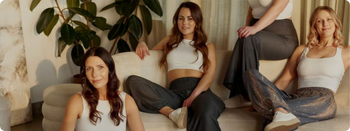



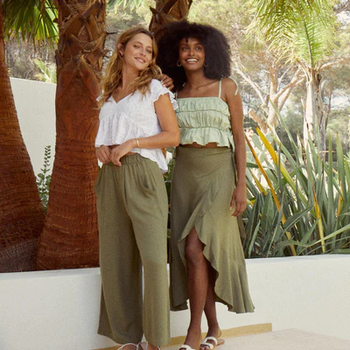
Viscose products
These instructions apply to our pants as well as our other viscose clothing.
Please observe the following when washing your viscose products
- Wash before wearing for the first time
- Wash the garments on a gentle cycle (e.g. delicate cycle) at a maximum of 30 degrees
- Make sure that your wash program does not have too high a spin speed preset. If possible and necessary, manually reduce the spin speed to 400–800 rpm
- Do not bleach
- Do not dry-clean
- Do not tumble-dry
Note: Some older harem pants still have washing instructions specifying hand washing. We initially included this as a precaution, but have now found that gentle machine washing is not a problem. You can therefore also wash these harem pants in the machine as described above.
- During the first few washes, the products may still lose a little color. The pattern will not wash out or discolor. This is because we avoid pre-washing the products several times during production in order to keep the environmental impact at the production site as low as possible. However, this is not a problem and will subside after the first few washes. If you are unsure, wash the items separately or use a color-catcher sheet.
- To avoid and prevent any pilling, you can use a lint brush on the garment before the first wash. Since we do not use chemical anti-pilling treatment after production, there may still be some lint on the fabric, which you can remove this way.
- Ironing: Use only a low temperature and preferably iron while damp.
- paigh viscose garments dry very quickly and are therefore particularly suitable for travel—not only because of their practical pack size and low weight.
- If you are unsure about washing an item, you can use a colour catcher cloth as a precaution to absorb any dye that may run during the first few washes.
- If the fabric contracts slightly and “shrinks” after washing, this is not necessarily a cause for concern. Viscose fibres can contract somewhat depending on the wash cycle and conditions. In most cases, you can restore the fabric yourself with a few simple tricks. Wash the item again and gently stretch the fabric on all sides and at the ends while it is still wet after washing. Then hang the item by the waistband, lengthwise, and leave the fabric to stretch and dry. If this does not work, please contact our support team at support@paigh.com so we can look for another solution.
- We have noticed that some trousers become slightly smaller after being stored for a longer period than other trousers of the same size. This is because the viscose fibres contract and the fabric becomes creased during storage. Gently ironing at a low temperature relaxes the fabric and can make the trousers up to 5 cm longer. If your trousers seem smaller or shorter than usual, you are welcome to try this ironing trick after the first wash, with no obligation. It also helps to stretch the fabric lengthwise and back into shape while it is still wet after washing. If this does not work or you have any questions, please feel free to contact us at any time at support@paigh.com.
Organic cotton products
These instructions apply to our Basic Collection and our Loungewear Collection. The respective care instructions can also always be found on the product.
- Wash the garments on a gentle cycle (e.g. delicate wash cycle) at a maximum of 30°C
- Do not bleach
- Do not dry-clean
- Do not tumble dry
- Iron: Low temperature only
- Household tip: Add half a cup of white distilled vinegar (5% acidity, or dilute vinegar essence 1:5 with water) to the washing machine’s fabric softener compartment. This keeps clothes soft and is especially practical for garments containing elastane, as it helps keep the elastane fibers soft and elastic. Vinegar is also a useful household remedy for more sustainable laundry in general. However, it’s best to find out more about the details beforehand :)
- To protect the beautiful fabric from excessive friction and strain during washing, you can wash the items inside out.
- Our trousers made from 100% Organic Cotton may initially produce some lint—this is part of the material’s natural quality. We deliberately avoid repeated pre-washing to conserve water and local resources. The excess fibers remaining in the fabric after production will come loose on their own after the first few washes. This makes the fabric stable and durable. We recommend using a lint roller on the trousers beforehand and washing them in a laundry bag so the lint can be caught.
- If present, tie the cords on the garments with a loose knot so they do not get caught anywhere or pull out